I try to remember here how I liked the books I read (and what books I read in the first place :-))
These books are only those that I really read to a big extent. So I leave out all the books I read half, but then had something better to do or technical books where I looked something up and then went on. And also I neglect Comics :-(
For the books I read in German, I will try to provide the english title.
2021
2020
2019
2018
2017
review
Homo economicus is dead as a complete model of human behaviour. When making economic decisions, people do not simply act rational - they also choose actions according to moral motivations like general fairness, relationships and identity. This moral part of economies is interesting by itself, but an important follow-up question is what this means for incentive schemes (e.g. taxes, fines, bonuses, etc.)?
Finding the answer requires a closer look at experiments with human participants - what are they thinking when they see a potential reward? It also requires an interesting discussion of why economic systems are so complex that there will be no perfect incentive scheme and no real equilibirum. Incentive designers can learn a lot from proven wisdom about contracts from ancient Greece and also need to consider the contemporary hot-button topic that trust and peer punishment work differently across the world's societies.
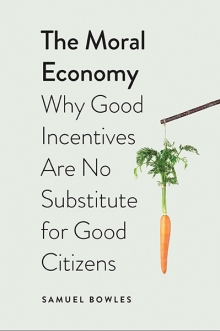
The topic of this book is human decision-making in direct economic interactions. It deals another jab at the concept of Homo economicus (the purely rational and payoff-maximising model of human decision-making) and at any incentive schemes which are entirely built on this model (e.g. Mechanism Design). However, Bowles spends most of his text in a constructive manner, talking about what we actually do know about how humans all over the world react to incentive schemes and what schemes actually do work or might work. These insights are built on careful research with real humans, by economists (among them Bowles himself) as well as anthropologists. This book is based on Bowles' Castle Lectures in Ethics, Politics and Economics at Yale University. For context, Bowles has also written books on microeconmics and the origins of human cooperation.
This book took me a while to digest. It is easy to read, but actually grasping the details requires some deep concentration. However, I believe it is important as this can serve as a source in any discussion of such issues - it combines scientific detail with constructive content. It is filled with history of economic thought, detailled descriptions of experiments and their interpretations (both readable by laymen and in a way economists can work with: function plots), as well as musings over what incentive schemes could actually work well together with morals. It spans a bridge between older theoretical discussions and current debates (for instance about the cultural differences between different countries' economies or the governments role in cultivating values). Therefore, herewith: a summary, so I don't forget what I got out of it. For anyone else, I guess this is a helpful starter which makes reading the actual book easier.
To give a first impression before summarising chapters, I will start with examples of incentive schemes which did and did not work and a short list of stronger statements expressed in this work (my copy is from the first edition, printed 2016 btw):
- "In Haifa, at six day care centes, a fine was imposed on parents who were late in picking up their children at the end of the day. It did not work. Parents responded to the fine by doubling the fraction of time they arrived late." (p.4)
- "Kids less than two years old avidly helped an adult retrieve an out-of-reach toy in the absence of rewards. But after they were rewarded with a toy for helping the adult, the helping rate fell off by 40 percent." (p. 5)
- "The small tax on plastic grocery bags enacted in Ireland in 2002 resembled the fine for lateness at the Haifa day care centers (...), but its effects could not have been more different: In just two weeks following its introduction, the use of the plastic bags dropped by 94 percent. (...) The monetary incentive was combined with a message of explicit social obligation" (p. 202f)
- The Athenian citizens' assembly, in 325 BCE, devised an incentive scheme in order to get a fleet for a major and risky naval adventure set up in a short amount of time, in a decentralised fashion (a subset of rich citizens each setting up a ship with everything needed). A mixture of prizes, praises, drastic fines and some smart mechanism design tricks did the job - the expedition got enough ships together in time and the rest is history. (from p. 187f)
Here is my attempt at summarising the major themes expressed in this book (I'll go into more detail afterwards):
1. Incentive mechanisms which do not take (pre-existing) moral preferences of humans into account are over-simplifying the process of human decision-making. They are making the dangerous assumption that moral preferences will not be affected by the incentives. They will be affected, as many people know and experiments prove, either negatively (moral preferences are "crowded out" - people act as if they don't have them) or positively (moral preferences are "crowded in" - people who usually don't act upon them do make use of them). For instance, moral preferences often are in line with what the incentive designer wants to achieve anyway (e.g. parents do think picking their kid up late is bad) and by adding the incentive, they are getting much less of an effect than they hoped for. Maybe even a negative effect (e.g. parents think since there is a price on it, it is now not a moral issue anymore).
2. This makes the design of incentive schemes, which we still need in our society, more difficult. Humans are not simplistic, so there is a lot to consider. But at least now we can understand what we are dealing with.
3. For example, moral preferences are often influenced by environmental factors, like who announces the incentive (for instance, a central designer or the peeers in a decentralised mechanism) or how a certain action fits to a desired self-image (which itself will differ between contexts). The message is not only the amount of the incentives, attached to it is the framing as "bribes, bonuses, incentives, salaries, (...) prizes, fines and punishments." (p. 97).
4. Moreover, some situations can only be solved in the moral sphere - "Morals must sometimes do the work of prices, rather than the other way round." This is based on the (recently) well-established notion that (especially modern) economies are rife with incomplete and asymmetric contract knowledge as well as externalities. This is also why mechanism design is not working. In turn, the use of trust and the belief that punishments by peers outside of clan structures has meaning are needed in populations and their presence needs to be accounted for in incentive schemes.
I will now move through the chapters, for a summary of Bowles' way of telling this story, from problem to possible solution:
The problem with Homo economicus & A constitution for knaves
The assumption that humans decide rationally and self-interested (Home economicus) has recently been attacked from two directions that have experimental support. The first attack direction (e.g. by Kahnemann but many others as well) shows that we are biased in our thinking and not rational. This book represents an attack of the second direction - we are not purely maximising our own gains when dealing with others.
Before presenting the major contribution this book wants to describe, Bowles gives a historical perspective. He shows how this second attack direction is not even a novel insight, citing thinkers like Aristotle, Aquinas, Rousseau, Burke and Confucius (p. 11). On the contrary side of this argument, claiming that people are mainly self-serving and should be treated as such, he cites thinkers like Machiavelli, Mandeville and also Smith and Mills. However, not one of these classical thinkers completely favoured a world where purely number-based incentives schemes would run a complete economy. Smith was aware of moral sentiments and paired natural liberty with a protective system of justice for all. Mills clearly states that his profession often makes an "entire abstraction of every other human passion or motive" in order to describe economies (p. 20f). In spite of their reserverations, number-based incentives and a favourisation of the Homo Oeconomicus model has taken over as a serious candidate for running our societies in the last century. Bowles does not muse how this process went about in the minds of journalists and decision makers in general, but he gives some details about how economists argued how markets could internalise morals if they only were sophistiated enough (e.g. Marshall & Pigou, who considered externalities, or Arrow who was concerned with if such a market is even theoretically possible). At the end of this (mostly misled) road of economic thought lies Mechanism Design, which is still around.
"So it is no surprise that except on the whiteboards of economics classrooms, people try to avoid dealing with Homeo economicus. Employers prefer to hire workers with a strong work ethic; banks prefer to lend to people whome they trust (...) - handshakes matter; and where they do not, the economy underperforms." (p. 34)
What Bowles considers the crucial novelty (within the recent work which attacks the notion of self-interested humans) is the proof that self-interest and morals are separable. Bowles uses different terms throughout, I like these ones to contrast: "self-interested motives" and "intrinsic motives". So if an incentive scheme designer does not think humans humans can be described by Homo economicus, can he or she at least treat self-interested motives and intrinsic motives separately when they design their scheme? That would indeed make it easier to handle the design task. This book spends the majority of its text to argue that they are not separable and how to think about this - both as economists and as incentive designers.
Moral sentiments and Material Interests
While the previous chapter was more an historical road through economic thought, this chapter lays down fundamental technical notions for this book. There are two of note:
First, Bowles dives into the experimental games which real humans played in decades of experimental behavioural economics research. He explains the details of eight games, e.g. One-shot or multi-shot prisoner's dilemma (with or without punishment of betrayal), Trust (with or without fines), Ultimatum or Dictator. These games have been played by humans in all roles, from CEOs in Western societies to villagers in rural India. While it is easy to show that Homo economicus is not a model that can explain a majority of actions in such situations, it is more challenging to develop a generic model of the differences that were found.
Bowles introduces his attempt at this in the second part of this chapter. He introduces the notion of "crowding in/out" - this is the term for moral preferences influencing the purely rational part of the effect incentives can have (see above). This section is quite technical and was for me the major hurdle to overcome. It is not that hard, though, it is simply required to digest this section in one sitting and not put the book down in between.
Incentives as information
Incentives contain more information than just the (monetary) gain or loss. Next to explaining a lot of experiments where this showed clearly, Bowles takes this "bad news" as an opportunity for a modern incentive scheme designer (a "legislator" as he calls this job) to check his toolkit (which is more than simply monetary distribution).
Bowles is fond of this list of important factors, worked out by Lepper at al:
1. The conditions the actors find themselves in can lead to moral disengagement. For example: Is the room well-lit? What names are chosen for the player roles, like "buyer" and "seller" instead of "proposer" and "responder". Is a third party observing the interactions? Can participants assume they will be held responsibility for their actions?
2. Also, the presumed motives of the person administering the incentives is additional and crucial information. For instance, are they self-serving or neutral?
3. Finally, the relationship between participants frames the situation as well. For example, incentives can signal control by authority and therefore lead to refusal of participation.
There is rich social science research to dive deeper into here, for example
"Alan Page Fiske provides (...) four psychological models (...): authoritarian, communal, egalitarian and market, each with culturally prescribed pattern of appropriate behaviour" (p.91)
"Tangible rewards may be framed as "bribes and bonuses, incentives and salaries" as Lepper [et al] say, and one might add "and as prizes, fines and punishments"". (p.96f)
What could possible responses for the legislator be? Bowles gives a short list at this point (but this was not easy to extract):
1. "Moral frames for social interactions are not difficult either to construct or to suppress" (p.97) Once you understand what you are dealing with, I might add...
2. Signal that you trust the participants. This works only with intrinsically motivated & fair-minded people. Payoff maximisers (~ 25% of people) will not respond.
3. Perform equilibrium selection by performing one-time interventions which challenge pre-conceived notions of both sides. Increase expectations of virtue, establishing trust. "Turn a vicious circle into a virtous one". (p. 97 ff)
Bowles also cites some neuro-imaging research that might shine some more light into the workings of incentives, but he is not convinced they are helpful at present date. In particular, neuro-imaging during behavioural economics experiments shows that the presence of a fine changes in which brain area most participants make their decision (p. 103 ff).
There seem to exist two modes of thinking. Bowles likes the metaphor, given by Neuroscience-philosopher Joshuah Greene, of a camera with two modes: an automatic settings or deliberate manual mode. In human brains, the former mode of thinking produces less rational & less self-interested behaviour than the latter.
A liberal civic culture
Bowles proposes a puzzle: If incentives have all these problems and complexities, why do we observe many strong economies with high and rather stable levels of trust and cooperation and not more often a race to either no incentive schemes or very strong and rigid incentive schemes?
Exposure to markets does not actually seem to be bad for morals, like Marx said. The long-term effects are difficult to study, though. Comparing different societies might be one way:
"Rural Missourians tend to vote Republican; but from this experimental evidence, they appear to be more concerned about economic inequality than the Hazda hunter-gatherers, whose practices of food sharing and lack of political hierarchy were the inspiration for James Woodburn's classic paper "Egalitarian Societies". Recall that the Hazda subjects offered a quarter of the pie on average in the Dictator game, and their MAO in the Ultimatum game was less than half of the Missourians." (p. 134)
Punishment of anti-social behaviour can deliver an important clue. It is a crucial ingredient in behavioral economics experiment which can sustain cooperation. However, it is used less by participants in societies with little rule of law, democracy, individualism and/or social equality. Bowles ponders that the difference can be explained in how punishment by peers is viewed - either it represents a legitimate criticism and acceptable part of societal discourse, or it is frowned upon (and seen as meddling with interal affairs that should be of no public concern.
"Boston subjects may have read the fine as disapproval by fellow citizens, while those in Dnipropetrovs'k may have seen it as an insult." (p.142)
In lineage-based and family-centered societies, outsiders of the personal circle may not criticise or punish. Bowles points out that
"[this hypothesis] has yet to be tested empirically, but if it were borne out, it would direct attention not to the cultural consequences of markets but rather to liberal political, judicial, and other nonmarket institutions as the key to liberal civic culture." (p.142)
In other words - as opposed to Smith, who believed that people become more cooperative & honest if they interact regularly in a marketplace (so that their trust score is crucial to them), Bowles favors the civic culture argument: Civic provisions like the rule of law and occupational mobility help markets thrive - in turn, markets lead to the advancement of universal standards (and thus larger structures like nation states which can make them happen, as opposed to island-like clan or feudal structures).
In his framework, this is a long-term crowding-in effect. If this effect happened or not is an interesting armchair discussion about the effects of markets but also highly relevant background information if one implements an incentive scheme.
The Legislator's dilemma
In this chapter, Bowles deals with the unattained lure of mechanism design (which promised the advent of complete incentive schemes, where almost any societal outcome could be guaranteed in decentralised decision processes if technically possible and the right payments were made). Already in 1971, Richard Titmus argued that
"explicit economic incentives may be counterproductive because they induce people to adopt a "market mentality" and such policies thus compromise preexisting values that lead people to act in socially beneficial ways."
This is a neat summary of a major theme in this book. However, in the 1970s there was little evidence for this. Also, the promise of mechanism design enticed many economists to not look into such claims further. They went on with the Homo economicus model for decades.
Now we have evidence of crowding out and the study of incomplete contracts is a counterweight to mechanism design.
"Economists were coming to see why prices alone could not always do the work of morals." (p. 153)
Also, economists came to better understand the long-term effects of incentives. The economist Robert Lucas researched the effect of taxes on the beliefs of citizens (showing that the effect exists) and dealt a blow to any believer in a static model:
"any change in policy will systematically alter the structure of econometric models."
Bowles further states that certain policies do more wrong than good, unless they capture the problem completely with prices, and the prices being correct. He explains the shortcomings of mechanism design in some details.
Finally, he offers to see markets through a novel lens: as learning environments. The bureaucratic structures which markets compete with, like states and communities (e.g. clans), can also be seen through the same lens. This lens (which can also be used to draw in earlier research by Max Weber, Buchanan and Parsons) allows for a new way of comparison. Markets can be both anonymous and personal, and they have the advantage of being flexible with respect to membership.
Finally, the fact that markets consist of incomplete contracts, which has been conclusively shown (and mechanism design wasn't able to show a way out), is for Bowles not only bad news, but in the light of markets as learning environments a good thing:
"Incomplete contracts cause market failures, as economists know, but they also encourage trust, which as Arrows says, may be essential to attenuating market failures. This (...) could be the basis of a kind of virtuous circle: the trust that is essential to mutually beneficial exchange when contracts are incomplete appears to be learned in precisely the kinds of trading relationships that evolve when contracts are incomplete. The virtuous cycle's vicious cousin also exists, of course." (p. 179)
Societies can shift towards trust & incomplete contracts, but also towards little trust & (seemingly) complete contracts. Bowles concludes this chapter with five uncomfortable facts about incentives:
- Incentives are essential to a well-governed society.
- Incentives cannot singlehandedly implement a fully efficient use of economic resources if people are entirely self-interested and amoral.
- Ethical and other social preferences are therefore essential.
- Unless designed to at least "do no harm", incentives may stand in the way of "creating better people".
- As a result, public policy must be concerned about the nature of individual preferences and the possibility that incentives may affect them adversely.
He laments his result to some degree, but to him this means that government might need to officially "cultivate some values and discourage others".
A mandate for Aristotles legislator
Bowles found a great example from ancient history where legislators successfully managed cooperative contributions. It is told that the Athenian assembly in 325 BCE found a way to encourage rich citizens to provide material contributions (think fully-equipped ships with troops) for a maritime expedition. It was a high-risk situation, as only a fleet of sufficient size would have had a chance of success.
The legislation is an ingenious mix between identity-promoting carrots (e.g. prizes for arriving first), giant sticks (e.g. penalties for arriving late) and some self-organising principles (e.g. you can refuse, but only by proposing someone else who you claim is richer than you - to the extent of agreeing to switch all their wealth with yours).
On the background of the earlier chapters, one appreciates the wisdom in such legislation and it becomes obvious how large parts of economic thought have led us astray in recent centuries.
Bowles now revisits several insights of the earlier chapters as constructive advice for a modern legislator:
- First, incentives are probably not actually the problem, but the context is: "The problem of crowding out may arise from the relationship between the person imposing the incentive and its target, or from the meaning of the incentive." (p.191)
- Second, self-image is crucial: People engaging in exchange of goods and services "are attempting not only to get things, but also to be someone" (p.192).
- Finally, experiments show that fines do have a moral effect on potential free-riders, not only a purely calculated one. The fines with the best effect are the ones given out by peers, and constraints most likely to be accepted are from third parties with no own stake. (p.200)
Based on these basic insights, there is some deeper advice about building a moral context:
- Do not blame individuals. Moral engagement is reached when "inspiring public aversion not of the transgressors, but of the habits and dispositions accounting for the transgressions" (p.201, citing Jeremy Bentham)
- Incentives need to be paired with a justification or "moral lesson", in order to "make it each man's interest to observe that conduct which it is his duty to observe" (p.200, also Bentham).
"Good policies and constitutions are those that support socially valued ends not only by harnessing self-interest but also by evoking, cultivating, and empowering public-spirited motives." (p.222)
Bowles now turns to a very practical problem: It is difficult to address groups with differing preferences (most groups consist of self-interested people as well as very fair-minded people), without creating adverse effects. Altruists react well to messages but not well to fines. Or, if altruism is increased, fines by peers go down, which increases free-riding.
The composition of the population is crucial. This knowledge has been around since Smith and Machiavelli, but mechanism design has tried to get rid off it. The legislator should aim to
"design rules (...) allowing the civic-minded, not the self-interested, to determine the outcome." (p.214)
Without some "good citizens", no incentive scheme will help building a constitution for civic-minded poeple.
Finally, Bowles revisits the larger picture of societies attempting to improve the level of morality among citizens. This can take different forms. The German Democratic Republic tried to create solidaristic citizens (but failed in this, as a recent experiment shows). In the 2008 housing crisis, the sentiment arose that home owners should, for the greater good, not strategically default on their underwater mortgages. And also public shaming of wrong-doers (price gougers, tax evaders, reckless drivers etc) has a long history that lives on to this day.
Following up ...
For me, the follow-up thoughts are as follows. A moral element to public policy is not radically new to societies. It is only novel in the light of the last 100+ years. It seems that in these 100+ years we are learning a lesson about how easily ideas that oversimplify human decision-making can gain a foothold in public debate and shape societies. It remains to be seen how fast we can get that ghost back in the bottle. However, with respect to where we are in 2017, it seems to me there are three points to make:
- Externalities are becoming more apparent in the current decade, as climate change becomes accepted and economic inequality rises to levels unseen since before the two world wars. Since externalities can be framed in the moral realm in a powerful way, maybe there is reason to welcome a strong role for morals in economic policy.
- In addition, we are also seeing a strong moral theme in public discussion, especially in the novel alt-right influence to politics, which is taking a strong tribal stance. These are already influencing economic schemes, e.g. leaving international cooperation frameworks like the climate deal or the EU. However, a strong influence of moral themes might actually revive the public policy debate, and next to harmful discussions, there might be room for discussions as the ones described in this book.
- Automation might also soon be taking hold in economic decision making, e.g. when we let automated agents do decisions on our behalf. The computer might be introducing a Homo economicus into our societies here, because when we defer economic actions to automated agents, it seems easier to detach our moral sentiments. We'd claim that we ourselves are not Homo economicus, but our automated software agents may very well be. In this scenario, we'll have to go through another learning process. However, there is a slightly different scenario, in which this is not a problem worth mentioning, because very few *economic* decisions are automated, or only ones which really should be done in a rational way (like waiting for a low electricity price to charge your car). I plan to think about examples for these two scenarios some more in the future.
2016
2015
2014
2013
2012
2011
2010
2009
review
I already mentioned some of the thoughts of this book here when I started it. Though it is pretty long, it was a rewarding read and I came back after a break from it to finish it.
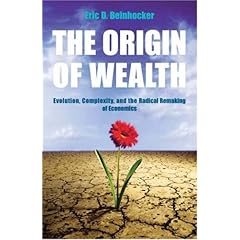 Beinhocker claims (and who would argue with him about it) that economics as we have it develops models that seldom relate to reality and leads to false predictions, false hopes and false politics. He argues for a new kind of economics, which he calls "Complexity Economics", in which it is acknowlegded that the human economy is one of the most complex systems imaginable and in a constant state of unrest (as opposed to the equillibrium view of traditional economics). He puts his case forward on the shoulders of many advancements in science: physics, psychology, sociology, computer science and systems research (of course, there have also been some economists who understood the problem).
The books proceeds in four parts:
- Beinhocker first explains how, when and by who the traditional economic models were first developed.
- He then explains several concepts which have been on the radar of other sciences in the last decades (and that, he is convinced, all show how the traditional models of economics is flawed): dynamics, agents, networks, emergence, evolution and cooperation. This part didn't contain too much new things for me, but was written well, I must say.
- Then, he goes on to define several design spaces that a new science, Complexity Economics, could make use of to formalise things. He says we should think about Physical Technologies, Social Technologies and Business Plans as three distinct ingredients. Then, Business Plans would make a good unit to be put under a selection pressure in an economic sense. Furthermore, the conditions of what constitutes economic activity should be discussed. In the new light of complexity, he proposes as a starting point that every activity should be irreversible and entropy-lowering in order to be counted as an economic activity.
- In the end, Beinhocker lines out what the effects of such a new way of looking at our main activities could have on several parts of our doings. How businesses develop their strategies should evolve to a more adaptive mind-set. The structure of organisations should be affected on all levels and be less rigid in order to tap more of the brainpower of employees. This way, he claims, a company could have the advantage to emerge better abilities to tackle complexity and enable endurance and growth (though this claim is not made very clear). Maybe we could even come to smarte financial indices than we have today. Lastly, politics could finally set their left-right divide aside, as Complexitiy Economics wouldn't be "owned" by any side.
It is always interesting to see when someone tries to put pieces together. Then, of course, he mixes facts with wishful thinking and it can be hard to set those apart. Then again, this book is meant to provoke discussion and in addition, he cites a lot of serious research so it's not just him talking. Actually, he cites some really interesting papers, some of which I had a closer look on.
Let's close with Beinhockers first sentences in the book:
"As I write this, the field of economics is going through its most profound change in over a hundred years. (...) I also believe that just as biology became a true science in the twentieth century, so too will economics come into its own as a science in the twenty-first century."
We'll see about that but I hope he's right.
review
Being a good scientist requires the ability to think in highly complex ways. Being a successful scientist requires even more: To wrap all this complexity up into a simple question/answer pair.
The reason behind this phenomena is that science has internal and an external aspect. Internally, things have to be sound and correct. New circumstances have to be modelled and put into numbers in a reasonable way. Some say there is even math and statistics involved. But externally, science has to communicate itself. It's about getting money and attention. But most importantly, it's about understanding. Why is this research important? Only if (s)he excels on both fronts will a researcher be really successful.
 Take Stephen D. Levitt. He is one of the highest-praised young economists in the USA. He is doing sound work of course, but his greatest ability is to ask simple and appealing questions and then answer them with complex statistics. Then, he published the answers in a highly readible book: Freakonomics. He asks qwuestions like "Do real estate agents actually work in the interest of their clients? What makes successful parents? Should we make DNA sampe of dog poo to identify owners who don't clean up?
Levitt can alternate between thinking simple and thinking complex. And he is not afraid to be heard asking asking seemingly childish questions.
In reality, Levitts simpe questions may sometimes be the result. What triggers most ersearch he did is the availability of good data. He performs regression analysis (in which one controls for all variables but one to test for its effects) and thus needs big data sets.
Most of these data sets are extensive surveys or test/competition results, but there us even the occasional curiosity like the crack dealer gangs bookkeeping records, secured by a colleague of Levitt.
So this may be what makes a creative scientist. Whatever comes first, a good question or a promising tool - Levitt is able to find the other and then formulate a good story around it.
P.S. Another thing that makes a good scientist is also related to communication: Being able to put your work in the context of other researchers. Levitt doesn't provide a lot about this, but that can have two reasons: First, Freaconomics is popular science so readers generally don't care. Second, this context-provision is most important for young scientist to be accepted (as I currently experience) and maybe becomes less important when you climb the ladder.